Wen urges "healthy" devt as China's economy slows


BEIJING: Chinese Premier Wen Jiabao has urged the central bank to promote "healthy" economic development, the government said, after the economy expanded at its slowest pace for 13 years in 2012.

Speaking on a visit to the headquarters of the People's Bank of China, Wen called on the central bank to push financial reform and use monetary policy to support the economy, the government said in a statement late on Monday.

"Financial work is still facing a severe and complicated domestic and overseas environment," Wen was quoted as saying.

"We must make full use of monetary policy for the economy to realise continued healthy development," he said, adding prices should be kept stable.

China's economy, the world's second largest, expanded 7.8 percent last year, the government announced on Friday, in the face of weakness at home and in key overseas markets.

The central bank last cut interest rates in July last year, and has instead used its open market operations to boost liquidity to support the economy as growth flagged in the second half.

Last week, the central bank said it would start carrying out short-term operations to manage liquidity in the money market, which analysts say will give policy-makers more flexibility.

Wen called for more financial reforms, including the long-held goals of further liberalising interest rates and making China's yuan currency freely convertible, but gave no details of such moves.

In June last year, the central bank gave banks more flexibility to set interest rates, effectively introducing greater competition and improving allocation of capital.

China last year also began allowing its tightly-controlled currency to trade in a wider band against the US dollar, on the long march for the yuan to become freely convertible.

But Wen also called for preserving financial stability, suggesting future reforms will continue to be incremental.

Wen is set to step down as premier in March, wrapping up a decade overseeing the government and economy.

Li Keqiang, a member of the ruling Communist Party's powerful Politburo Standing Committee, is touted to replace him amid hopes the new leadership might be more aggressive in promoting economic reforms.

- AFP/al


Read More..

North Korea lets foreigners bring in cell phones


North Korea's army.


(Credit:
CBS/Randy Schmidt)


North Korea is easing some of strict cell phone rules -- now, visitors can bring their own mobile devices into the country, according to the Associated Press.

While this may seem like a minor move on the part of the North Korean government, it is actually a big step for one of the most closed-off countries in the world. Despite the ease in regulations, foreigners are still not allowed to talk to any locals via mobile device.

For years North Korea's authorities made visitors leave their cell phones at the border or airport when arriving to the country, according to the Associated Press. Now, the new rules allow foreigners to bring their own WCDMA-compatible phones or rent a mobile and buy a local SIM card at the airport. These SIM cards allow calls to Japan and the U.S., but not South Korea.

This change in the rules may have been brought on by Google Executive Chairman Eric Schmidt's recent trip to the country in his push to get North Korea's government to give its citizens more Internet access. On his visit, Schmidt elected to leave his phone in China and rent a local handset.

"We left our phones and laptops behind in China, since we were warned they'd be confiscated in NK, and probably infected with lord knows what malware," Schmidt's daughter, who accompanied her father to North Korea, wrote in a blog post yesterday.

North Korea is known for restricting its citizens' access to cell phones. In 2008, the government banned the use of cell phones to prevent its residents from sharing news about a worsening food crisis. And in December 2010, after the death of president Kim Jong-il, all cell phone use was prohibited during a 100-day mourning period. Those people caught using a mobile device were considered war criminals and "punished accordingly."

The ongoing bans on cell phones seems to stem from the government's desire to keep a tight reign on information flow in and out of the country. According to the Associated Press, more than 1 million North Koreans now have cell phones and that number is growing. However, 1 million people is still less than 5 percent of the country's total population.

Read More..

Obama looks to past to set course for future

News Analysis

President Obama is a student of history - it was no coincidence that he formally announced his run to become the first African-American president back in 2007 at the Old State Capitol in Springfield, Illinois, where Abraham Lincoln delivered his "house divided" speech in 1858 - and his inaugural address today drew an unmistakable line between the nation's past and its prospects for the future.


Play Video


President Obama's second inaugural speech


The president opened his remarks by referencing Lincoln's words from that speech, stating that America came to realize at that point in history that "no union founded on the principles of liberty and equality could survive half-slave and half-free." He grounded his remarks in the Declaration of Independence's claim that "all men are created equal," tying it to both the American Revolution and rules mandating that there is fair play in the free market, to the need for a great nation to "protect its people from life's worst hazards and misfortune."

Later, he again invoked the declaration - though this time, he referred to the notion that "all of us are created equal" - before referencing three landmark moments in the battle for civil rights: The Seneca Falls Convention for women's rights, the clashes in Selma for African-American rights and the riots at New York's Stonewall Inn for gay rights. (The speech marked the first presidential inaugural in which LGBT rights have been referenced.)

He then pivoted from the triumphs of the past to the necessity of continuing the fight, calling for equal pay for women, equal rights for gay men and women, an elimination of long lines to vote, better treatment of immigrants, and, in an indirect reference to his desire to pass gun control legislation, the necessity of children from Detroit to Appalachia to Newtown to know "that they are cared for, and cherished, and always safe from harm."


Play Video


Brinkley on inaugural address: "A great civil rights speech"


At five separate moments in his second inaugural address, delivered to an estimated 500,000 to 700,000 people at the Capitol, Mr. Obama uttered the words "We, the people" - the opening words to the preamble of the Constitution. Those words were deployed to underscore the president's argument that Americans need to recognize that we are all in it together - and that while America celebrates initiative and enterprise, "preserving our individual freedoms ultimately requires collective action."

"For the American people can no more meet the demands of today's world by acting alone than American soldiers could have met the forces of fascism or communism with muskets and militias," he said. "No single person can train all the math and science teachers we'll need to equip our children for the future, or build the roads and networks and research labs that will bring new jobs and businesses to our shores. Now, more than ever, we must do these things together, as one nation, and one people." He went on to add that "we are made for this moment, and we will seize it - so long as we seize it together."

That idea underscored the positions Mr. Obama reiterated during the speech, which at times came closer to a policy-oriented State of the Union Address than an inaugural, which historically tends to be more about soaring rhetoric. (The president will offer his State of the Union on February 12.) In addition to arguing that economic inequality hampers the nation's success, he said that the future depends on harnessing "new ideas and technology to remake our government, revamp our tax code, reform our schools, and empower our citizens with the skills they need to work harder, learn more, and reach higher."

"We do not believe that in this country, freedom is reserved for the lucky, or happiness for the few," said the president. "We recognize that no matter how responsibly we live our lives, any one of us, at any time, may face a job loss, or a sudden illness, or a home swept away in a terrible storm. The commitments we make to each other - through Medicare, and Medicaid, and Social Security - these things do not sap our initiative; they strengthen us. They do not make us a nation of takers; they free us to take the risks that make this country great."

Mr. Obama also fit a call for a renewed focus on fighting climate change - an issue largely absent from his first-term agenda - into the notion of collective action for the common good, saying that "the failure to [address it] would betray our children and future generations."


Play Video


Axelrod on Obama's vision for economy


In addition to climate change, Mr. Obama's second term agenda involves pushing passage of gun control and immigration legislation, overseeing the further implementation of the health care law, winding down the war in Afghanistan, and continuing to try to find some way to come to a major agreement with Republicans to address the nation's massive debt and deficit.

He has signaled that to accomplish these goals, he will take a more confrontational approach with Republicans than he did in his first term -- an approach illustrated by his recent refusal to negotiate on raising the debt limit. His inaugural address offered little in the way of appeals for Washington bipartisanship; instead, Mr. Obama called on Americans in and out of the nation's capitol to come together to help the nation stay on the right path, even if the results are sometimes "imperfect."

"Progress does not compel us to settle centuries-long debates about the role of government for all time - but it does require us to act in our time," he said. "For now decisions are upon us, and we cannot afford delay."

It was an appeal grounded in the notion that America's strength comes from all its citizens, no matter their status. And it was offered by a president who knows the debt he owes to history - a president who sees himself both as a symbol of American progress and a vessel to keep it moving forward.

Read More..

Inauguration: 7.5 Things You Should Have Seen


A presidential inauguration is a big, long event that lasts all day and into the night–and who has time to really watch it? People have jobs, ones that don’t let you off for a federal holiday.


Everyone (or, at least, some) will be talking about it, which means potential embarrassment for anyone who doesn’t know what happened. Thankfully, ABC employs  news professionals stationed in Washington, D.C., to pay attention to these kinds of things and boil off some of the less noteworthy or interesting stuff, presenting you with short videos of everything that really mattered. Or at least the things a lot of people were talking about.


A full day of paying attention to President Obama’s second Inauguration leads one of those professionals to offer these 7 1/2 things:


1. Beyonce Sang the National Anthem


Boy, howdy! Did she ever? Beyonce has essentially become the Obama’s go-to female performer: She recorded a music video for Michelle Obama’s “Let’s Move” initiative in 2011, and she performed at the president’s last inauguration in 2009. Her velvety, soulful “Star Spangled Banner” is getting good reviews.


2. Kelly Clarkson Also Sang


Kelly Clarkson is not as “in” with the First Couple as Beyonce seems to be, but they let her sing “My Country ‘Tis of Thee,” and she did a pretty good job with it. This was kind of weird, though, because at one point she said she loved Ron Paul, although she later said she would vote for Obama.


3.  Obama Talked About Gay Rights


This may not seem shocking since more than half the country, including President Obama, supports gay marriage. But the president made a point of mentioning gay rights during his speech, equating the struggles of the LGBT community with those of  past civil rights movements, and in doing so made history.


He name-checked Stonewall, the New York City bar that was raided by police in 1969 sparking riots to protest the anti-gay crackdown. And he actually used the word “gay”: “Our journey is not complete until our gay brothers and sisters are treated like anyone else under the law – for if we are truly created equal, then surely the love we commit to one another must be equal as well,” Obama said in his address.


Plenty of inaugural addresses have been chock full of rhetoric about freedom and equality, but in the last four years, the political culture surrounding gay rights has changed significantly, as more states legalized same-sex marriage and as broad swaths of the country got more comfortable with homosexuality in general. Obama’s “evolution” on gay marriage, and now his inaugural address, have helped signify that change.


4. Joe Biden Made Jokes and Shook Hands With People


Could we expect anything less?


Here’s how the Vice President toasting Sen. Chuck Schumer instead of President Obama at the big luncheon:  ”I raise my glass to a man who never, never, never operates out of fear, only operates out of confidence, and a guy–I’m toasting you, Chuck.” Watch it:


And here he is, scurrying around and jovially shaking hands with people along the parade route:


5. Richard Blanco Read a Poem That Was Sort of Whitman-esque, But Not Entirely


Cuban-born Richard Blanco became America’s first openly gay, Latino Inauguration poet. He read a nine-stanza poem entitled “One Today,” which set a kind of unifying American tableau scene.


6. Obama and Michelle Walked Around Outside The Limo


President Obama walked part of the parade route, from the Capitol to the White House, with Michelle. They waved to people. It is not entirely abnormal for a president to do this at an inaugural parade. But they walked quite a ways.


7. John Boehner: ‘Godspeed’


The speaker of the House presented American flags to Obama and Biden, telling them: “To you gentlemen, I say congratulations and Godspeed.”


7 1/2. Sasha and Malia Were There. 


Obama’s daughters, Sasha and Malia, were there. They didn’t really do much, but they did wear coats of different shades of purple that got a lot of  attention on Twitter.


Reports of the daughters looking at smartphones and applying lip gloss highlighted their day. As did this .gif of Sasha yawning.

Read More..

Algeria hostage toll rises with report of Japanese deaths


ALGIERS, Algeria (Reuters) - The hostage death toll from a four-day siege at an Algerian gas plant deep in the Sahara has risen to almost 60, with at least nine Japanese nationals also reported killed in an attack claimed by a veteran Islamist fighter on behalf of al Qaeda.


Algerian Prime Minister Abdelmalek Sellal is expected to give details at a Monday news conference about one of the worst international hostage crises in decades, which left American, British, French, Japanese, Norwegian and Romanian workers dead or missing.


A security source said on Sunday Algerian troops had found the bodies of 25 hostages, raising the total number of hostages killed to 48 and the total number of deaths to at least 80. He said six militants were captured alive and troops were still searching for others.


That number climbed further on Monday when a Japanese government source said the Algerian government had informed Tokyo that nine Japanese had been killed, the biggest toll so far among foreigners at the plant.


One-eyed veteran Islamist fighter Mokhtar Belmokhtar claimed responsibility for the attack on behalf of al Qaeda.


"We in al Qaeda announce this blessed operation," he said in a video, according to Sahara Media, a regional website. He said about 40 attackers participated in the raid, roughly matching the government's figures for fighters killed and captured.


The fighters swooped out of the desert and seized the base on Wednesday, capturing a plant that produces 10 percent of Algeria's natural gas exports, and residential barracks nearby.


They demanded an end to French air strikes against Islamist fighters in neighboring Mali that had begun five days earlier. However, U.S. and European officials doubt such a complex raid could have been organized quickly enough to have been conceived as a direct response to the French military intervention.


The siege turned bloody on Thursday when the Algerian army opened fire saying fighters were trying to escape with their prisoners. Survivors said Algerian forces blasted several trucks in a convoy carrying both hostages and their captors.


Nearly 700 Algerian workers and more than 100 foreigners escaped, mainly on Thursday when the fighters were driven from the residential barracks. Some captors remained holed up in the industrial complex until Saturday when they were overrun.


The bloodshed has strained Algeria's relations with its Western allies, some of whom have complained about being left in the dark while the decision to storm the compound was being taken. Nevertheless, Britain and France both defended the Algerian military action.


"It's easy to say that this or that should have been done. The Algerian authorities took a decision and the toll is very high but I am a bit bothered ... when the impression is given that the Algerians are open to question," said French Foreign Minister Laurent Fabius. "They had to deal with terrorists."


British Prime Minister David Cameron said in a televised statement: "Of course people will ask questions about the Algerian response to these events, but I would just say that the responsibility for these deaths lies squarely with the terrorists who launched this vicious and cowardly attack.


"We should recognize all that the Algerians have done to work with us and to help and coordinate with us. I'd like to thank them for that. We should also recognize that the Algerians too have seen lives lost among their soldiers."


Algeria had given a preliminary death toll of 55 - 23 hostages and 32 militants - on Saturday and said it would rise as more bodies were found.


STAFF MISSING


The security source said that toll did not include the bodies of 25 hostages found on Sunday. The search was not over, and more could yet be found, he said.


Before Monday, the Japanese government and engineering firm JGC Corp, which had several dozen employees working at the plant, had said only that 10 Japanese were unaccounted for.


JGC is due to give an update regarding its staff in Algeria later on Monday.


Among other foreigners confirmed dead by their home countries were three Britons, one American and two Romanians. The missing include five Norwegians, three Britons and a British resident. The security source said at least one Frenchman was also among the dead.


Algeria is determined to press on with its energy industry. Oil Minister Youcef Yousfi visited the site and said physical damage was minor, state news service APS reported. The plant would start up again in two days, he said.


The Islamists' assault has tested Algeria's relations with the outside world and exposed the vulnerability of multinational oil operations in the Sahara.


Algeria, scarred by the civil war with Islamist insurgents in the 1990s which claimed 200,000 lives, insisted from the start of the crisis there would be no negotiation in the face of terrorism.


France especially needs close cooperation from Algeria to crush Islamist rebels in northern Mali.


(Additional reporting by Anton Slodkowski in Tokyo, Balazs Koranyi in Oslo, Estelle Shirbon and David Alexander in London, Brian Love in Paris and Daniel Flynn in Dakar; Writing by Peter Graff; Editing by Paul Tait and Nick Macfie)


Read More..

Thai deputy PM dies of suspected heart problem


BANGKOK: Thai deputy prime minister and minister of tourism and sports Chumpol Silpa-archa, aged 72, died on Monday of a suspected heart problem, his party said.

Chumpol, the leader of the Chart Thai Pattana Party -- a member of Prime Minister Yingluck Shinawatra's ruling coalition -- was admitted to hospital with breathing problems on December 17.

"We received news that he passed away this morning," Chart Thai Pattana spokesman Vachara Kannikar said.

"We don't know the cause of death yet but I think it could be linked to his heart problem."

He was one of several deputy premiers serving under Yingluck.

- AFP/al


Read More..

NFC: Not just for mobile payments anymore


LG demos NFC technology in appliances at the Consumer Electronics Show in Las Vegas.


(Credit:
Sarah Tew/CNET)


Move over, mobile payments. NFC is finding other ways to make itself useful.

In fact, paying for items with one's phone seems to be the least common use for the close-range connectivity technology right now, at least based on gadgets unveiled at the Consumer Electronics Show. Rather, essentially all products using NFC shown at the recent confab employed the technology in one of two ways: To set up a sort of digital handshake between a mobile device and another gadget or as a way to share information between products with just a tap.

"NFC really simplifies things," Scott McGregor, CEO of connectivity chipmaker Broadcom, told CNET at
CES. "The most advanced technology is stifled if it's not easy to use. ... NFC plays a very valuable role in simplifying user interfaces for consumer products."

NFC is short for near-field communication, a chip technology that allows devices to transfer small amounts of data between each other. Both devices must contain NFC chips and must be closer than an inch to connect. Typically, NFC works by tapping the two devices together to securely exchange data such as credit card information, train tickets, coupons, press releases, and more.

NFC has long been hailed as the technology to bring mobile payments, or the idea of waving your phone in front of a cash register to purchase a good, closer to reality. However, the mobile payments trend has been slow to take off, and it continues to face many hurdles for adoption. While the technological issues have largely been resolved, there just aren't that many stores and point-of-sales terminals equipped with NFC for widespread use.

But at CES, NFC popped up in nearly everything imaginable (just not at cash registers). Along with the usual devices, like smartphones, there were speakers, cameras, televisions, refrigerators, business cards, and numerous other items. Some companies, such as Panasonic, have even added NFC to rice cookers and other usual items.


Sony introduced speakers with NFC technology at CES.


(Credit:
Sarah Tew/CNET)


NFC is already becoming a familiar spec in smartphones. Aside from mobile payments, many handset vendors have been using NFC technology as a way to differentiate their products from rivals, particularly the iPhone. Apple is the most notable NFC holdout, though it's widely expected to incorporate the technology into future devices.

Samsung, meanwhile, has been one of the biggest companies pushing the technology. It has released several ads that show what users can do with NFC (like sharing videos by tapping two Galaxy S3 phones together), and it also has slammed the iPhone 5 for its lack of sharing capabilities. At CES, the company unveiled speakers that use NFC to pair a phone to the device. Content is then streamed via Bluetooth.

And Sony included NFC in nearly all of its products shown at CES, including TVs, smartphones, remotes, and speakers. The company, which dubbed the technology "One Touch," said during its press conference that it offers more NFC-enabled products than any other electronics maker in the world. Sony noted the technology would ease media transfer and streaming among phones,
tablets, TVs, and audio devices by establishing a link between them just by touching the devices to one another.

"Customers are asking for easy, seamless ways to be able to access and transfer their personal content," Brian Siegel, Sony vice president of marketing, told CNET at CES. "We've been talking about it collectively for a long time, and it's been this combo of wireless and wired solutions. NFC and Sony's One Touch, we believe, is the easiest solution ever brought to market."

Panasonic unveiled a couple cameras with the technology, and LG also incorporated NFC into its electronics, as well as its appliances such as washing machines, vacuums, and refrigerators. In the case of appliances, people will be able to pair their smartphones with the product and then control it remotely, like turning on the washing machine while still in the office.

NFC has many benefits over other connectivity technology. Most important, it allows users to bypass all the steps required to set up something like Bluetooth. Just think about how long pairing a phone to a Bluetooth speaker takes. You have to discover the device, enter passwords, etc. For less tech savvy users, simply getting two devices to talk to each other can be daunting. With NFC, it's one tap and the items are paired.

It can even be used to get information from a poster or other non-electronic device by installing passive NFC tags in the item. Unlike NFC readers, which are used in smartphones and other electronic devices, the passive tags don't need batteries, and they're very cheap, costing only pennies. An NFC-enabled smartphone is able to decipher the information on the tag by sending energy to it to power it up and receive the data.

Caesars Entertainment, owner of eight hotels and casinos in Las Vegas, is making use of such technology. It installed more than 4,500 interactive Samsung TecTiles in its resorts, allowing anyone with an NFC-enabled device to tap the various TecTiles for information such as game tutorials, show times, restaurant menus, and ticket purchases.

"People are talking about putting them in virtually every consumer device," Henry Samueli, Broadcom co-founder and board chairman, told CNET at CES. "You could walk through your grocery store, and something you buy for a couple dollars could have a tag. That would be useful for stores for inventory control and things like that, and for the consumer, it's a fast way of exchanging information."


The Panasonic Lumix TS5 features NFC capabilities.


(Credit:
Panasonic)

By getting NFC into more devices, companies are easing consumers into the idea of using the technology, which should help when (if) mobile payments take off. Because NFC is a secure technology, it's still seen as an ideal way to handle mobile transactions.

"NFC was very present at CES, but it had nothing to do with payments," Gartner analyst Carolina Milanesi said. "It's smart because you're getting consumers familiar with the technology so when mobile payments is ready and the ecosystem ready, they'll feel comfortable with it."

Of course, NFC isn't perfect. Because the technology requires two devices to be very close to each other, it won't be replacing Bluetooth or Wi-Fi anytime soon. Those longer-range connectivity technologies will still be required for streaming content. Also, in the early days of NFC, it was hard to figure out where to tap to make the connection.

In addition, while NFC technology itself is a standard, not all NFC products work together. That's because companies incorporate their own software into the systems, limiting what devices the products work with. That helps create brand loyalty (if you have a Samsung phone and want to stream content to your TV, it's easier to also own a Samsung television), but it also limits what consumers are actually able to do with their products.

Market watchers say that should change as industry groups and companies agree on a standard. And in time, NFC might actually show up in the majority of consumer electronics.

"Right now you see Samsung commercials where you tap a Galaxy S3 with another and you're exchanging videos." Gartner analyst Mark Hung said. "That's great, but try doing that with a Nokia phone. All these other companies also have NFC, but interoperability leaves much to be desired. I expect that to be sorted out this year."


Samsung handed out wristbands with NFC technology at its CES press conference.


(Credit:
James Martin/CNET)

Here are some products that use NFC (Note: not all of these were announced at CES):
  • Virtual press kits and business cards -- Various execs and companies used NFC as a fast way to share their contact information and press releases. All people meeting them had to do was tap their NFC-enabled phone (sorry, iPhone users) to the item, typically a wristband or business card, to access the information. Samsung, for example, handed NFC-enabled wristbands to all attendees at its press conference, and Sharp gave out business cards embedded with its press release.

  • Information points such as posters -- Caesars Entertainment, owner of eight hotels and casinos in Las Vegas, installed more than 4,500 interactive Samsung TecTiles in its resorts. Anyone with an NFC-enabled device will be able to tap the various TecTiles for information such as game tutorials, show times, restaurant menus, and ticket purchases.

  • Speakers -- NFC is typically used in these devices to pair a smartphone to a speaker. The music is not actually streamed to the system via NFC but is shared through Bluetooth. Samsung and Sony were two notable companies with NFC speakers.

  • Headphones -- The function is much like wireless speakers. Users tap their phone to the headphones to allow pairing for the transfer of music. Sony also makes these.

  • Boomboxes and other music players -- Sony, again.

  • Cameras -- At least two cameras introduced at CES included NFC capabilities: The Panasonic Lumix ZS30 and the Panasonic Lumix TS5. Along with built-in Wi-Fi, the cameras should enable "the widest range of remote shooting options, remote viewing, and instant sharing on social networks."

  • TVs -- LG and Sony were a couple big companies showing off NFC-enabled TVs at CES. Like with audio devices, NFC is used to pair a phone to the TV by tapping the two together.

  • Remote controls -- In this instance, users tap their phones to their remote instead of their TV to pair the device to the television. Sony is one company doing this.

  • Appliances -- LG showcased a slew of washers, dryers, ovens, refrigerators, and vacuums with NFC technology. After pairing the appliance with a phone, users can program their products from afar, such as turning on a washing machine while still in the office.

  • Other weird kitchen items -- Panasonic's Asian operations have made an NFC-enabled rice cooker and a steam microwave oven. Users can search for recipes and program cooking instructions using their smartphones.

  • Computers -- HP's SpectreOne all-in-one desktop PC, announced in September, incorporates NFC technology, which it calls HP TouchZone. Via a sensor built into the base of the unit, users can log into the SpectreOne or transfer files to it by simply swiping a smartphone or another device equipped with NFC. HP's Envy 14 Spectre ultrabook also includes NFC, as does Sony's Vaio Tap 20 mobile desktop PC.

  • Smart meters for utility companies -- Landis+Gyr in late 2011 said it was working with NXP Semiconductor on energy management products with integrated NFC.

  • Digital bubble gum machine -- Digital advertising agency Razorfish last July developed a high-tech prototype version of the gum ball machine that allows users to download digital content like apps and movies to their NFC-enabled phone for a small fee.

  • Heart monitor -- Impak Health, a joint venture between Swedish chipmaker Cypak and U.S.-based Meridian Health, developed the RhythmTrak heart monitor. The product tracks certain heart-related data, which can then be downloaded or sent to a clinician by placing it next to an NFC-enabled phone.

  • Wii U -- It's not really clear how NFC will be used in this Nintendo console, but it may allow users to do things like add new characters to games.

  • Cars -- An NFC-enabled smartphone will be able to unlock Hyundai cars by 2015.


Read More..

MLK's "content of character" quote inspires debate

"I have a dream that my four little children will one day live in a nation where they will not be judged by the color of their skin but by the content of their character."

This sentence spoken by the Rev. Martin Luther King Jr. has been quoted countless times as expressing one of America's bedrock values, its language almost sounding like a constitutional amendment on equality.


20 Photos


Martin Luther King Jr.


Play Video


Martin Luther King III talks his father's legacy


Play Video


King, Civil Rights Act remembered


Yet today, 50 years after King shared this vision during his most famous speech, there is considerable disagreement over what it means.

The quote is used to support opposing views on politics, affirmative action and programs intended to help the disadvantaged. Just as the words of the nation's founders are parsed for modern meanings on guns and abortion, so are King's words used in debates over the proper place of race in America.

As we mark the King holiday, what might he ask of us in a time when both the president and a disproportionate number of people in poverty are black? Would King have wanted us to completely ignore race in a "color-blind" society? To consider race as one of many factors about a person? And how do we discern character?

For at least two of King's children, the future envisioned by the father has yet to arrive.

"I don't think we can ignore race," says Martin Luther King III.

"What my father is asking is to create the climate where every American can realize his or her dreams," he says. "Now what does that mean when you have 50 million people living in poverty?"

Bernice King doubts her father would seek to ignore differences.

"When he talked about the beloved community, he talked about everyone bringing their gifts, their talents, their cultural experiences," she says. "We live in a society where we may have differences, of course, but we learn to celebrate these differences."

The meaning of King's monumental quote is more complex today than in 1963 because "the unconscious signals have changed," says the historian Taylor Branch, author of the acclaimed trilogy "America in the King Years."

Fifty years ago, bigotry was widely accepted. Today, Branch says, even though prejudice is widely denounced, many people unconsciously pre-judge others.

"Unfortunately race in American history has been one area in which Americans kid themselves and pretend to be fair-minded when they really are not," says Branch, whose new book is "The King Years: Historic Moments in the Civil Rights Movement."

Branch believes that today, King would ask people of all backgrounds - not just whites - to deepen their patriotism by leaving their comfort zones, reaching across barriers and learning about different people.

"To remember that we all have to stretch ourselves to build the ties that bind a democracy, which really is the source of our strength," Branch says.

Bernice King says her father is asking us "to get to a place - we're obviously not there - but to get to a place where the first thing that we utilize as a measurement is not someone's external designation, but it really is trying to look beyond that into the substance of a person in making certain decisions, to rid ourselves of those kinds of prejudices and biases that we often bring to decisions that we make."

That takes a lot of "psychological work," she says, adding, "He's really challenging us."

For many conservatives, the modern meaning of King's quote is clear: Special consideration for one racial or ethnic group is a violation of the dream.

The quote is like the Declaration of Independence, says Roger Clegg, president of the Center for Equal Opportunity, a conservative think tank that studies race and ethnicity. In years past, he says, America may have needed to grow into the words, but today they must be obeyed to the letter.

"The Declaration of Independence says all men are created equal," Clegg says. "Nobody thinks it doesn't really mean what it says because Thomas Jefferson owned slaves. King gave a brilliant and moving quotation, and I think it says we should not be treating people differently on the basis of skin color."

Many others agree. King's quote has become a staple of conservative belief that "judged by the color of their skin" includes things such as unique appeals to certain voter groups, reserving government contracts for Hispanic-owned businesses, seeking more non-white corporate executives, or admitting black students to college with lower test scores.

In the latest issue of the Weekly Standard magazine, the quote appears in the lead of a book review titled "The Price Was High: Affirmative Action and the Betrayal of a Colorblind Society."

Considering race as a factor in affirmative action keeps the wounds of slavery and Jim Crow "sore and festering. It encourages beneficiaries to rely on ethnicity rather than self-improvement to get ahead," wrote the author, George Leef.

Last week, the RightWingNews.com blog included "The idea that everyone should be judged by the content of their character, not the color of their skin" in a list of "25 People, Places and Things Liberals Love to Hate."

"Conservatives feel they have embraced that quote completely. They are the embodiment of that quote but get no credit for doing it," says the author of the article, John Hawkins. "Liberals like the idea of the quote because it's the most famous thing Martin Luther King said, but they left the principles behind the quote behind a long time ago."


1/2


Read More..

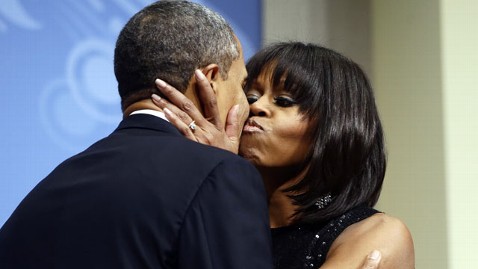
Obamas Share the Love, Even for Michelle's Bangs


Jan 20, 2013 10:49pm


ap obamas 130120 wblog Obama Calls First Ladys Bangs Most Significant Event of Inaugural Weekend

(Charles Dharapak/AP Photo)


President Obama used the first public remarks of his second term to address what he called the “most significant” event of this weekend: his wife’s much-talked-about new haircut.


“I love her bangs,” Obama told supporters at an inaugural reception at the National Building Museum. “She looks good. She always looks good.”


First lady Michelle Obama, wearing a black sequined cocktail dress and showcasing her new hairdo, also heaped compliments on her husband.


“Let me tell you, it has just been a true thrill to watch this handsome, charming individual grow into the man and the president that he is,” she said, as she reached out to playfully touch the president’s face, sparking laughter from the crowd.


Praising his compassion and courage, the first lady introduced the president as the “love of her life.”


Obama, who was sworn in for a second term in a small White House ceremony earlier today, kept his remarks short, noting he has another big speech to deliver Monday.


“There are a limited amount of good lines and you don’t want to use them all up tonight,” he joked.


Because the Constitutionally mandated date for the inauguration, Jan. 20, fell on a Sunday this year, the traditional, public ceremony was delayed until Monday.


Saving the best for his official inaugural address, the president instead dedicated the bulk of his remarks to thanking supporters for their hard work and dedication to getting him re-elected.


“You understood this was not just about a candidate; it was not just about Joe Biden or Barack Obama. This was about us, who we are as a nation, what values we cherish, how hard we’re willing to fight to make sure that those values live not just for today but for future generations,” he said.


“All of you here understood and were committed to the basic notion that when we put our shoulders to the wheel of history, it moves… It moves forward. And that’s part of what we celebrate when we come together for inauguration,” he said.


SHOWS: World News


Read More..

Algeria ends desert siege with 23 hostages dead


ALGIERS/IN AMENAS, Algeria (Reuters) - Algerian troops ended a siege by Islamist militants at a gas plant in the Sahara desert where 23 hostages died, with a final assault which killed all the remaining hostage-takers.


Believed to be among the 32 dead militants was their leader, Abdul Rahman al-Nigeri, a Nigerien close to al Qaeda-linked commander Mokhtar Belmokhtar, presumed mastermind of the raid.


An Algerian interior ministry statement on the death toll gave no breakdown of the number of foreigners among hostages killed since the plant was seized before dawn on Wednesday.


Details are only slowly emerging on what happened during the siege, which marked a serious escalation of unrest in northwestern Africa, where French forces are ratcheting up a war against Islamist militants in neighboring Mali.


Algeria's interior ministry said on Saturday that 107 foreign hostages and 685 Algerian hostages had survived, but did not give a detailed breakdown of those who died.


"We feel a deep and growing unease ... we fear that over the next few days we will receive bad news," said Helge Lund, Chief Executive of Norway's Statoil, which ran the plant along with Britain's BP and Algeria's state oil company.


"People we have spoken to describe unbelievable, horrible experiences," he said.


British Prime Minister David Cameron said he feared for the lives of five British citizens unaccounted for at the gas plant near the town of In Amenas, which was also home to expatriate workers from Japanese engineering firm JGC Corp and others.


One American and one British citizen have been confirmed dead. Statoil said five of its workers, all Norwegian nationals, were still missing. Japanese and American workers are also unaccounted for.


The Islamists' attack has tested Algeria's relations with the outside world, exposed the vulnerability of multinational oil operations in the Sahara and pushed Islamist radicalism in northern Africa to center stage.


Some Western governments expressed frustration at not being informed of the Algerian authorities' plans to storm the complex. Algeria, scarred by a civil war with Islamist insurgents in the 1990s which claimed 200,000 lives, had insisted there would be no negotiation in the face of terrorism.


President Barack Obama said on Saturday the United States was seeking from Algerian authorities a fuller understanding of what took place, but said "the blame for this tragedy rests with the terrorists who carried it out."


Official sources had no immediate confirmation of newspaper reports suggesting some of the hostages may have been executed by their captors as the Algerian army closed in for the final assault on Saturday.


One source close to the crisis said 16 foreign hostages were freed, including two Americans and one Portuguese.


BP's chief executive Bob Dudley said on Saturday four of its 18 workers at the site were missing. The remaining 14 were safe.


PLANNED BEFORE FRENCH LANDED IN MALI


The attack on the heavily fortified gas compound was one of the most audacious in recent years and almost certainly planned long before French troops launched a military operation in Mali this month to stem an advance by Islamist fighters.


Hundreds of hostages escaped on Thursday when the army launched a rescue operation, but many hostages were killed.


Before the interior ministry released its provisional death toll, an Algerian security source said eight Algerians and at least seven foreigners were among the victims, including two Japanese, two Britons and a French national. One British citizen was killed when the gunmen seized the hostages on Wednesday.


The U.S. State Department said on Friday one American, Frederick Buttaccio, had died but gave no further details.


U.S. Defense Secretary Leon Panetta said nobody was going to attack the United States and get away with it.


"We have made a commitment that we're going to go after al Qaeda wherever they are and wherever they try to hide," he said during a visit to London. "We have done that obviously in Afghanistan, Pakistan, we've done it in Somalia, in Yemen and we will do it in North Africa as well."


Earlier on Saturday, Algerian special forces found 15 unidentified burned bodies at the plant, a source told Reuters.


Mauritanian news agencies identified the field commander of the group that attacked the plant as Nigeri, a fighter from one of the Arab tribes in Niger who had joined the Algerian Salafist Group for Preaching and Combat (GSPC) in early-2005.


That group eventually joined up with al Qaeda to become Al Qaeda in the Islamic Maghreb (AQIM). It and allied groups are the targets of the French military operation in Mali.


The news agencies described him as "one of the closest people" to Belmokhtar, who fought in Afghanistan and then in Algeria's civil war of the 1990s. Nigeri was known as a man for "difficult missions", having carried out attacks in Mauritania, Mali and Niger.


NO NEGOTIATION


Britain, Japan and other countries have expressed irritation that the Algerian army assault was ordered without consultation.


But French President Francois Hollande said the Algerian military's response seemed to have been the best option given that negotiation was not possible.


"When you have people taken hostage in such large number by terrorists with such cold determination and ready to kill those hostages - as they did - Algeria has an approach which to me, as I see it, is the most appropriate because there could be no negotiation," Hollande said.


The apparent ease with which the fighters swooped in from the dunes to take control of an important energy facility, which produces some 10 percent of the natural gas on which Algeria depends for its export income, has raised questions over the country's outwardly tough security measures.


Algerian officials said the attackers may have had inside help from among the hundreds of Algerians employed at the site.


Security in the half-dozen countries around the Sahara desert has long been a preoccupation of the West. Smugglers and militants have earned millions in ransom from kidnappings.


The most powerful Islamist groups operating in the Sahara were severely weakened by Algeria's secularist military in the civil war in the 1990s. But in the past two years the regional wing of al Qaeda gained fighters and arms as a result of the civil war in Libya, when arsenals were looted from Muammar Gaddafi's army.


(Additional reporting by Balazs Koranyi in Oslo, Estelle Shirbon and David Alexander in London, Brian Love in Paris; Writing by Giles Elgood and Myra MacDonald)


Read More..